

Bigfoot Search Gear: Essential Field Kit for 2026
Table of Contents
- Bigfoot Search Gear: What Actually Belongs in Your Pack
- The Hiking Essentials Checklist for Cryptid Field Days
- Wilderness Safety Gear You Should Never Skip
- Bigfoot Search Clothing: Layers, Footwear, and Trail-Ready Prints
- Camera, Audio, and Evidence-Recording Setup
- Matching Gear to Terrain, Weather, and Budget
- Gifts for Bigfoot Enthusiasts Who Already Own the Basics
- Conclusion
- Frequently Asked Questions
Last Updated: October 19, 2026
Bigfoot Search Gear: What Actually Belongs in Your Pack
Bigfoot search gear is the field kit you carry into the woods to look for evidence of Sasquatch: optics, a light, navigation tools, recording equipment, and a way to stay safe. Most of it is ordinary hiking kit. A few items are specific to cryptid hunting.
The kit that works is not the biggest one. It is the one you can carry all day and still use well at dusk.
Below, we break down exactly what goes in the pack, what to skip, and how to match gear to your terrain and budget.
The Hiking Essentials Checklist for Cryptid Field Days
Start with a standard hiking essentials checklist, then add your cryptid-specific items on top. A search that ends in a rescue is not a good search. The National Park Service guidance on hiking safety is a sensible baseline for any trip.
Here is the checklist we would actually carry:
- Water and a backup filter or purification tablets
- Extra food, one full meal beyond your plan
- Map and compass, plus a charged phone
- Headlamp with spare batteries
- Rain shell and a warm mid-layer
- First aid kit with blister care
- Whistle and a small mirror for signaling
- Sun protection: hat, sunscreen, glasses
- Knife or multi-tool
- Emergency shelter or bivvy
- Field notebook and pencil
- Trekking poles if the ground is steep
Print that list. Tape it inside your pack lid. The people who get into trouble are usually the ones who trusted memory.

Wilderness Safety Gear You Should Never Skip
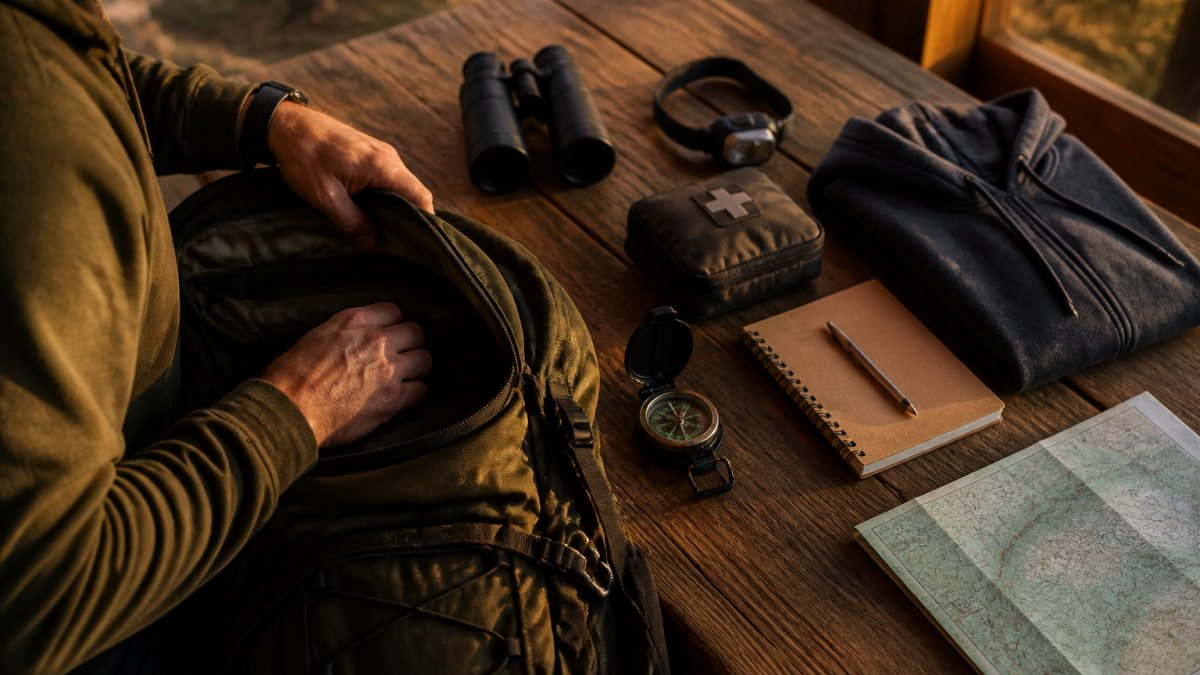
Safety gear is the part of the kit people cut first, and it is the part that matters most on a Bigfoot search. Cryptid hunting adds two risks ordinary hiking does not: you tend to go off-trail at dawn or dusk, and you tend to stand still and listen for long stretches, which is exactly when weather and daylight get away from you. Build the safety layer around four jobs: find your way back, call for help, stay warm, and treat a injury.
Navigation that does not depend on a battery. Carry a paper topographic map of the exact area and a baseplate compass, and know how to take a bearing before you need one. A phone with a downloaded offline map is a backup, not a primary. A common pattern among experienced searchers is to mark their vehicle and their turnaround time on the map before leaving the trailhead, so the decision to turn back is made in daylight, not at dusk.
Communication and signaling. Cell coverage is unreliable in the areas people search. A whistle carries farther than your voice and weighs almost nothing; three blasts is the universal distress signal. A small signal mirror works in sun. If you go out often, a personal locator beacon or satellite messenger is the one piece of electronics worth its weight, because it works where phones do not. Tell a responsible person your route and expected return time, and stick to it.
Warmth and shelter. A lightweight bivvy or emergency blanket weighs very little and can save your night if weather turns. Pack a warm mid-layer even on mild days; standing still in a cold forest drains heat faster than walking. A headlamp with spare batteries is non-negotiable, because a search that runs long runs into dark.
First aid and self-care. A small kit with blister care, an elastic wrap, antihistamine, and any personal medication covers most field problems. Blisters and rolled ankles end more searches than wildlife does. Carry more water than you think you need and a backup filter or purification tablets.
A simple emergency plan. Before you leave, agree on a turnaround time, a meeting point, and a check-in call. If someone is overdue, the person at home should know your route and who to call. Most practitioners find that the searches that go wrong are the ones with no plan beyond "we'll be back before dark."
Bigfoot Search Clothing: Layers, Footwear, and Trail-Ready Prints
Bigfoot search clothing works on two levels: it has to keep you comfortable on the trail, and it should look the part. Layers beat single heavy garments every time.
The layer system:
- Base layer: moisture-wicking synthetic or wool. Never cotton next to skin.
- Mid layer: fleece or light insulated jacket for warmth.
- Shell: waterproof, breathable outer layer for wind and rain.
Footwear. Choose boots or trail shoes with real tread and ankle support for uneven ground. Break them in before a long day.
Prints. This is where Squatch Wear comes in. Our hoodies and T-shirts feature original hand-drawn graphics. They are clothes you can wear to the trailhead and to the pub after.
Camera, Audio, and Evidence-Recording Setup
Recording gear is where cryptid hunting departs from ordinary hiking. You are trying to capture something rare, fast, and far away, so speed and reach matter more than megapixels.
Camera settings that help:
Northern California Bigfoot Sightings - Notebook →
- Use a fast shutter speed to freeze motion. Blurry blobs prove nothing.
- Zoom with your feet when you can. Digital zoom destroys detail.
- Keep a spare battery warm in a pocket in cold weather.
Audio. A small digital recorder captures sounds your phone misses. Note the time and location of every clip.
Evidence discipline. Record the date, time, weather, and location for every photo. A sighting without context is just a story.
Matching Gear to Terrain, Weather, and Budget
The right kit depends on where you search, what season it is, and what you can spend. The table below is a starting point, but the reasoning behind it matters more than the rows.
| Terrain / Condition | Priority Gear | Skip or Downgrade |
|---|---|---|
| Dense forest, short trips | Compass, headlamp, trekking poles, short-range binoculars | Long-range optics, spotting scope |
| Open ridge, long sightlines | Binoculars, spotting scope, sun protection | Heavy shelter, extra layers |
| Wet, cold weather | Shell layer, spare socks, bivvy, insulated mid-layer | Cotton anything, electronics without waterproof cases |
| Hot, dry country | Water filter, sun hat, electrolytes, light layers | Heavy insulated layers, bulky boots |
| Tight budget | Map, compass, whistle, headlamp, first aid | Gadgets, scopes, duplicate tools |
| Bigger budget | Better optics, audio recorder, satellite messenger | Duplicates you won't carry |
Terrain reasoning. In dense forest, sightlines are short, so long-range optics are dead weight; you need navigation, a good light, and quiet footing. On open ridges, the opposite is true: binoculars and a spotting scope earn their weight, and you can leave the heavy shelter behind if the weather is stable. Wet, cold country punishes cotton and rewards a shell and spare socks. Hot, dry country is a water problem first and a gear problem second.
Seasonal adjustments. Spring and fall mean mud, variable temperatures, and early dark, so add traction, a warm mid-layer, and a second light. Summer means heat, insects, and longer daylight, so prioritize water treatment and sun protection. Winter searches are a different sport: insulation, traction, and a hard turnaround time matter more than optics.
Budget tiers. On a tight budget, buy the safety items first and the fun items later. A cheap compass and a good headlamp will serve you better than an expensive scope you leave in the car. A sensible starter kit is a map and compass, a headlamp with spare batteries, a whistle, a first aid kit, a rain shell, and a notebook. A mid-tier kit adds better binoculars, a lightweight bivvy, and a small digital audio recorder. An advanced kit adds a spotting scope, a satellite messenger, and a dedicated camera with a fast lens. The trade-off at every tier is the same: weight and cost versus the chance you will actually carry it.
What to skip. Gadgets that need a signal, duplicate tools, and anything you have not tested in the rain. A cheap piece of gear that fails is worse than no gear, because it teaches you to trust it.
For field notes, a dedicated notebook beats a phone. The Leave No Trace principles also apply here: pack out everything, stay on trails where they exist, and leave wildlife undisturbed.
Gifts for Bigfoot Enthusiasts Who Already Own the Basics
Once someone has the basics, gifts get harder. The good news is that Bigfoot enthusiasts tend to love anything with a Sasquatch on it, especially if it is useful.
Our picks from the Squatch Wear shop:
- Bigfoot Sightings notebooks. Our spiral notebooks come in state-themed covers, including Northern California, Washington, Oregon, and South Carolina. Each has 118 ruled pages on 90gsm paper, a metal spiral that lies flat, and an internal pocket for maps and permits. At $19.99, they are an easy gift for a hiker who takes notes.
- Hoodies and T-shirts. Original artist-designed graphics.
- Trucker hats and raglan shirts. Good for sunny days and layering.
Gift shoppers who do not follow cryptid culture can still get this right. Pick something useful, pick something with a Sasquatch on it, and you are done.

Conclusion
Building a Bigfoot search gear kit is not about buying the most. It is about carrying the right items, knowing how to use them, and staying safe while you look.
Squatch Wear makes the fun half of that kit: durable hoodies, T-shirts, and field notebooks with original cryptid designs. Free shipping applies on orders over $75, and our small family brand ships worldwide.
Get started with Squatch Wear and gear up for your next trip into the woods.
Frequently Asked Questions
What gear do you need for a Bigfoot search?
Start with navigation and safety basics: a map and compass, a charged headlamp with spare batteries, a first aid kit, water, and weather-appropriate layers. Add observation tools like binoculars and a camera with a fast shutter speed, plus an audio recorder for night listening. A field notebook keeps your sightings and times organized. Bigfoot search gear should keep you safe and comfortable first, because most time in the field is spent hiking and waiting, not filming.
What should I pack for a Bigfoot-themed hike?
Treat it like any day hike with a few extras. Pack water, snacks, a rain shell, a warm mid-layer, sun protection, and a small first aid kit. Then add cryptid-specific items: a headlamp for dawn and dusk, binoculars, a notebook for sketches and notes, and a camera. A hiking essentials checklist keeps you from forgetting the boring but critical items. Wear broken-in boots and a Bigfoot search clothing layer that handles brush and changing weather.
Do you need special equipment for cryptid hunting?
No specialist equipment is required. Standard outdoor gear covers almost everything: navigation tools, lighting, layers, and a first aid kit. The useful additions are recording tools, such as a camera with a fast shutter speed for low light and an audio recorder for nighttime sound. Extra batteries and a waterproof bag protect that gear. Spend your budget on reliable basics and safe footwear before buying anything marketed as cryptid-specific.
What are useful gifts for Bigfoot enthusiasts?
Gifts that work on and off the trail tend to land best. A Bigfoot sightings spiral notebook gives them a place for field notes, sketches, and trail permits, and the internal document pocket keeps maps tidy. Pair it with a hoodie or trucker hat they can wear on hikes. For someone who already owns the gear, a themed T-shirt or graphic shirt adds personality without duplicating equipment. Squatch Wear ships worldwide and offers free shipping on orders over $75.